
Analysis: Gupta's fate may hinge on witnesses, not wiretaps - Reuters
NEW YORK |
NEW YORK (Reuters) - Through phone logs, trading records and a parade of witnesses, U.S. prosecutors repeatedly worked to connect the dots between Rajat Gupta, the former head of top consulting firm McKinsey & Co, and his hedge fund manager friend Raj Rajaratnam.
It is now up to a Manhattan federal jury to decide if this evidence against Gupta, a former board member at Goldman Sachs Group Inc and Procter & Gamble Co, is persuasive enough to convict him.
Historically, insider trading cases have been difficult for prosecutors to win because of their circumstantial nature. The investigation of Rajaratnam -- built on eight months of court-approved wiretaps and culminating in his conviction at trial last year -- was a major exception because the government had dozens of secretly recorded telephone calls of him discussing stock tips with friends and associates.
In the Gupta case, prosecutors only had a few wiretaps they could use to bolster their charges that Gupta supplied Rajaratnam with some of his juiciest tips. They had no telephone recording between the two men to back one of their most dramatic contentions: that Gupta, a minute after disconnecting from a Goldman board conference call on September 23, 2008, told Rajaratnam about plans by Warren Buffett's Berkshire Hathaway to inject $5 billion in the investment bank.
The jury heard evidence that Rajaratnam hurriedly ordered his traders at hedge fund Galleon Group to try to buy $40 million worth of Goldman stock in the few minutes that remained in the trading day after he received that 35-second call from Gupta.
"There was only one call to Rajaratnam's direct line in the last 10 minutes of the trading day, only one call in the last hour," Assistant U.S. Attorney Richard Tarlowe said in his closing argument Wednesday. "And it was from Rajat Gupta."
Gupta's defense lawyer, Gary Naftalis, responded: "If he was truly rushing, he wouldn't have waited a minute, he would have called in two or three seconds."
Lawyers following the trial have different opinions about how the jury might view the circumstantial evidence.
JaneAnne Murray, a white-collar defense attorney and professor at the University of Minnesota Law School, said even circumstantial government evidence in the trial could overwhelm the defense's case.
"The 'wrong place in the wrong time' defense works once, maybe twice," said Murray, who is not involved in the case. "The problem is when one is trying to defuse too many suspicious instances."
But Chicago securities lawyer Andrew Stoltmann, who is also not involved in the case, said the lack of direct evidence could lead the jury to acquit Gupta. An acquittal would halt the office of Manhattan U.S. Attorney Preet Bharara's run of victories in a series of insider trading trials over the past 15 months.
Gupta has said all along that he would put up a vigorous defense, describing the prosecutors evidence as purely speculative and circumstantial.
Defense lawyers wanted to play the jury wiretaps of a Goldman Sachs employee tipping off Rajaratnam about other companies to demonstrate that the money manger had other potential sources of information on the firm. The judge ruled that evidence was inadmissible because it was separate from anything in the indictment of Gupta and was likely to confuse the jury.
Gupta is charged with securities fraud and conspiracy, which carry a maximum prison term of 25 years.
BUSINESS AND FRIENDSHIP
Throughout the four-week trial, prosecutors also emphasized the years of friendship and business dealings between Rajaratnam and Gupta as evidence of how the defendant would benefit from conspiring with the hedge fund manager.
They also pulled out some star witnesses, including Goldman Chief Executive Officer Lloyd Blankfein, who testified that board conversations were always confidential and that he never authorized Gupta to share material corporate information with an outsider.
Defense lawyers sowed a few seeds of reasonable doubt, arguing that their client had no motive to leak inside information. They presented evidence that Rajaratnam had cheated Gupta out of $10 million in a joint investment called Voyager Capital Partners. The defense said the two had had a falling out in 2008.
Gupta's lawyers suggested that their client's calls to Rajaratnam could have been about the Voyager investment. "He was trying to get information on Voyager, and it had nothing to do in the world with Berkshire Hathaway," Naftalis said.
Geetanjali Gupta, the eldest of the defendant's four daughters, testified to her father's distress over Rajaratnam's handling of the investment at the time.
The jury also heard from associates and old friends that Gupta was respected for his integrity and had nothing to gain financially from helping Rajaratnam.
"There will be a lot discussion in the jury room about motive and lack of motive," said Tom Dewey, a partner at law firm Dewey Pegno & Kramarsky in New York, who is not involved in the trial.
The jurors paid very close attention throughout the trial to both sides of the case, with about half of them taking notes on yellow legal notepads.
Gupta at one point appeared likely to testify, but in the end did not.
He may have missed a chance to tell the jury his version of events, create more reasonable doubt and bring out more about his work in efforts to fight AIDS, malaria and tuberculosis in developing countries.
"Better than his lawyer, nobody could have sold the explanation better than Gupta as to why he did what he did," said securities lawyer Stoltmann.
The most important wiretaps in the case were conversations between Rajaratnam and two of his senior employees.
In one call, the day after the Buffett investment announcement, Rajaratnam told trader Ian Horowitz: "I got a call at 3:58, right? ... Saying something good might happen to Goldman."
On October 24, 2008 Rajaratnam is caught on the wiretap telling portfolio manager David Lau: "Um, now I, I heard yesterday from somebody who's on the board of Goldman Sachs, that they are gonna lose $2 per share. The Street has them making $2.50."
Prosecutors said Gupta had called Rajaratnam on October 23, 2008, only 23 seconds after a Goldman board meeting heard the firm was headed toward its first quarterly loss ever as a public company.
The case is USA v Gupta, U.S. District Court for the Southern District of New York, No. 11-907.
(Additional reporting by Basil Katz; Editing by Martha Graybow and Lisa Von Ahn)
Insight: JPMorgan bets sent false signals to wider debt market - Reuters
NEW YORK |
NEW YORK (Reuters) - JPMorgan Chase & Co's disastrous bets on corporate debt may have caused unexpected collateral damage: erratic behavior in a barometer that measures the financial health of blue-chip U.S. companies.
Those bets used Wall Street derivatives called credit default swaps. They are supposed to act like homeowners insurance, allowing bondholders, banks and hedge funds to buy protection against declines in the value of corporate debt, and ultimately protection against a default.
In this case, though, they became more like the pawns in a battle between JPMorgan and hedge funds on the other side of its bet. This struggle so dominated a corner of the market that it sent false negative signals about the credit quality of some major companies whose underlying finances were largely unchanged, market experts said.
A Reuters analysis shows that in recent weeks the trading may have sharply increased the cost of default insurance for companies such as railroad operator CSX Corp and McDonald's Corp.
In late April, CSX indicated it was in good financial shape. The company reported first-quarter earnings that beat analysts' expectations, while ratings agency Standard & Poor's said it expected CSX's credit "to remain satisfactory."
Yet the cost to insure against a default at CSX surged 28 percent to $64,300 for five-year protection on $10 million in debt on May 14 from $50,100 on May 1. At the same time, the company's stock fell just 5 percent.
A CSX spokesman declined to comment.
There was a similar pattern at McDonald's. The cost of protecting the fast-food company's debt against default rose more than 19 percent to $24,300 on May 14 from $20,400 on May 10, while McDonald's stock fell just 1.1 percent.
Again, there was no news during that time to explain a significant increase in the cost of default insurance. "It's business as usual for us at McDonald's," spokeswoman Becca Hary said when asked about the jump.
CRITICAL PERIOD
The first two weeks of May were a critical period because JPMorgan announced May 10 that a flawed trading strategy led to at least $2 billion in paper losses for the bank. The losses could eventually total $5 billion or more, analysts said.
Trading in default insurance for major U.S. companies showed unusual spikes during that time.
To be sure, renewed concerns about the U.S. economy and the European debt crisis are at least partly responsible for increasing worries about companies' financial health. There is no way to quantify whether JPMorgan-related trading contributed more or less than the broader economic concerns to the increases in costs for credit default insurance.
A JPMorgan spokeswoman said there was no causal link between the credit derivatives prices and the trading tied to the bank's losses. The theory, she said in an emailed statement, "is wrong and ridiculous."
But the Reuters analysis showed the 121 companies underlying the index of credit derivatives at the heart of the trading battle had a sharper increase in default insurance costs than 41 companies in a separate index that was not believed to be part of the big bets.
The trend held true even when distressed companies, whose default insurance costs are more sensitive to market movements, were removed from the analysis. Reuters used data from Markit, the index publisher, for the analysis.
New York University finance professor Marti G. Subrahmanyam, who looked at the results of Reuters' analysis, disputed JPMorgan's statement that there was no cause-and-effect relationship between the big bets and the subsequent increase in default insurance costs.
"How could it be otherwise?" Subrahmanyam said. "The whole market knows that one agent has a substantial position, and the market will react to that."
WIDER INFLUENCE
Peter Tchir of TF Market Advisors, a financial advisory firm in New Canaan, Connecticut, analyzed the trading in May and said the spikes in default insurance were a result of the struggle between JPMorgan and the hedge funds. That type of trading "can just influence the whole market," Tchir said.
On Friday, Barclays Capital analysts said default insurance for some companies was more expensive than their credit quality seemed to warrant.
Making a direct comparison is impossible because there are no companies that are exactly similar to the 121 in the index at the center of the trades, Subrahmanyam cautioned.
But if the broader economic concerns were the dominant factor, companies in the unrelated index should have had an equally strong jump in the cost of their credit insurance, Subrahmanyam said.
A surge in credit default swap prices can sometimes make a big difference for companies. When the cost of insurance increases, it can signal a company is in trouble because investors, increasingly worried that debt won't be repaid, buy more protection against default.
For example, the cost to protect against default at Bank of America Corp climbed last autumn, sending jitters through the stock market.
A company's borrowing costs can be affected. At least 33 of the 121 companies in the credit default swap index in the JPMorgan trades have loan commitments from banks whose interest rates are tied to various versions of the index or their individual default insurance costs. Companies use these loan commitments to provide cash for day-to-day operations.
Financially strong companies typically do not tap the loan commitments except in times of stress.
A look at one credit agreement illustrates how borrowing costs can be affected. Caterpillar Inc has a $3.9 billion loan commitment whose interest rate will go up if its five-year default protection increases, according to Thomson Reuters LPC data.
From May 1 to May 14, the construction equipment maker's five-year default insurance has increased to $104,000 a year from $82,900. That means that if Caterpillar had to tap the loan commitment, its cost to do so would have increased. Under the agreement, though, the company's interest rates on the loan would be calculated based on a maximum default insurance cost of $100,000.
A Caterpillar spokesman declined to comment.
(Editing by Dan Wilchins, Alwyn Scott, Martin Howell and Lisa Von Ahn)
Golf-Teenager Zhang relishes Tiger time at U.S. Open - Reuters UK
SAN FRANCISCO, June 13 |
SAN FRANCISCO, June 13 (Reuters) - It has been a dizzying, exciting and nervous start to the U.S. Open week for Chinese teenager Andy Zhang who has shaken hands with Tiger Woods and sat in the same interview chair as Jack Nicklaus.
Just two days ago, the 14-year-old Zhang was told he had gained a spot in the 156-player field for the year's second major, making him the youngest player to compete in the event since World War Two.
He is possibly the youngest U.S. Open competitor ever, but the tournament's records are not fully comprehensive before 1945.
Whichever way you look at it, Zhang's achievement is remarkable and he has earned the respect of golfing heavyweights such as 14-times major winner Woods and defending U.S. Open champion Rory McIlroy.
Woods made a point of walking up to Zhang on the practice range at the Olympic Club and shaking his hand, leaving the young Chinese spell-bound.
"I was on the range, hitting balls," Zhang told reporters on Wednesday about his surprise encounter with the former world number one. "My buddy, Chris, he was like, 'Hey, Andy look behind you, it's Tiger'.
"I looked back, it was Tiger walking up. I got really excited, and he actually came up to me and shook my hand. And I was like, 'Wow, I just shook Tiger's hand'. Obviously I'm really excited."
Zhang, who is based in Florida and does his school work on-line, earned his place in the U.S. Open on Monday when Britain's Paul Casey withdrew from the event because of a shoulder injury.
"I don't have that high (level) of expectation for this time," Zhang said of his goals for this week. "I just want to come out here, enjoy myself and learn as much as possible, just have fun, I guess."
Northern Irishman McIlroy, himself aged just 23, believes that is the best strategy for Zhang as he competes this week on golf's biggest stage.
WORDS OF WISDOM
"When I was 14 I was getting prepared to play in my club championship, not the U.S. Open," world number two McIlroy grinned, "so I'm not sure I could give him any words of wisdom.
"I think he should just enjoy it, take it all in and just realise that he's got so much more time to develop and mature. By the time he's 18 he'll feel like a veteran."
For the moment, Zhang is simply trying to calm his nerves and handle the bright glare of the media spotlight as best he can.
"I am really excited to be the first person that's a 14-year-old to play in this event and I'm trying to get used to all these media and fans coming up to me and sign autographs," he said.
"I am shaking a little right now sitting here," Zhang added while facing a packed interview room. "I heard Jack Nicklaus was sitting in this chair this morning. Was he?"
Golfing great Nicklaus certainly was, being honoured by the United States Golf Association in the same room earlier in the day on the 50th anniversary of his first U.S. Open victory.
"So I'm trying to get used to all this," Zhang said. "I'm not doing quite well right now."
Zhang has already done well enough this week, and benefited from having a practice round on Tuesday with Masters champion Bubba Watson and Australian Aaron Baddeley.
"And Bubba, I thought I was going to be looking up to him but actually he's just a normal person," Zhang said. "He was really nice to me and he gave me a lot of good tips."
Zhang will make his U.S. Open debut when he tees off in Thursday's opening round with Japan's Hiroyuki Fujita and American Mark Wilson. (Reporting by Mark Lamport-Stokes in San Francisco; Editing by Frank Pingue)
Emeli Sande and Conor Maynard to get Silver Clef awards - BBC News
Brits Critic's Choice winner Emeli Sande is to be recognised for "innovation in music" at this year's Silver Clef awards luncheon.
The Scottish singer-songwriter said she was "thrilled" and was "looking forward" to the event.
The annual Silver Clef awards raise funds for the charity Nordoff-Robbins, which provides music therapy for adults and children.
Sande will be presented with her award at the London Hilton on 29 June.
The 25-year-old began writing songs when she was just eight. She has collaborated with UK artists including Professor Green, Tinchy Stryder and Cheryl Cole.
Sande's debut album, Our Version of Events, recently topped the UK album chart.
She is also an ambassador for Nordoff Robbins Scotland and is planning to donate proceeds from her Glasgow Clyde Auditorium show on 6 November to the charity.
Also receiving the Silver Clef Best Newcomer award at the June event will be teenage newcomer Conor Maynard.
The 19-year old singer from Brighton found fame after uploading music onto YouTube.
In December he was selected as MTV's Brand New for 2012 artist and has been described as the UK's answer to Canadian pop superstar Justin Bieber.
Commenting on the prize, Maynard said: "The Awards have celebrated some of the most iconic artists in the last forty years, and it is incredible to be anywhere near that list."
"I'm really looking forward to it and can't thank Nordoff Robbins enough," he added.
Sande and Maynard will join Andrew Lloyd Webber, Jessie J, Michael Buble and Laura Wright who have already been announced as this year's other Silver Clef award recipients.
CORRECTED-UPDATE 1-Colorado, New Mexico forest fire crews gain ground - Reuters UK
(Corrects origins of Smokey Bear in 16th paragraph)
* Fires among biggest in both states' history
* Containment lines cut around 10 pct of Colorado fire
* Lines extended around 35 pct of New Mexico fire
By Zelie Pollon and Keith Coffman
June 12 (Reuters) - Fire crews battling flames roaring through national forests in New Mexico and Colorado have made some progress beating back the blazes that have driven thousands from their homes and destroyed hundreds of dwellings, the authorities said on Tuesday.
The larger of the two blazes, now ranked as the third biggest on record in Colorado, has killed a woman whose remains were found in the ashes of a cabin where she lived alone on the edge of the Roosevelt National Forest, officials said on Monday.
Linda Steadman, 62, was the first casualty of the so-called High Park Fire, which has scorched more than 43,000 acres (17,400 hectares) near the Wyoming border since it was ignited by lightning late Friday or early Saturday, and the fourth fatality in a Colorado wildfire this year.
Over 100 structures, including an undetermined number of homes, have been destroyed, and hundreds more dwellings - home to roughly 2,000 people - remain threatened by the blaze and are under evacuation orders, Larimer County officials said.
But authorities on Tuesday night reported making some headway against the flames, saying ground crews had managed to cut containment lines around 10 percent of the fire's perimeter. Residents from a couple of neighborhoods would be allowed back into their homes Tuesday afternoon, they added.
Still, federal incident commander Bill Hahnenberg said he anticipated firefighters would be battling the blaze for several weeks, if not into the fall. The plan for Tuesday, he said, was to focus on the southern edge of the fire with a heavy aerial assault to safeguard populated areas.
About 500 firefighters were on the scene on Tuesday, but Hahnenberg said he expected that number to climb to as many as 800 in the days ahead.
"SMOKEY BEAR" FIRE SITE
Hundreds of miles to the south, firefighters also turned a corner against a wildfire burning in the rugged Lincoln National Forest in central New Mexico, where some 37,000 acres (15,000) of mixed conifer have gone up in flames.
By Tuesday night, fire crews had extended containment lines around 35 percent of the perimeter of the Little Bear Fire, helped by calmer winds and higher humidity, officials said.
Damage-assessment teams reaching the fire zone for the first time on Tuesday determined that 224 homes and 10 outbuildings had been destroyed. Previously, it had been estimated that 35 structures had been burnt down.
Nine residential areas - which are home to up to 2,500 people - remain evacuated, while the resort village of Ruidoso, a town of some 9,000 year-round residents, is still under threat, said Kerry Gladden, a Ruidoso information officer.
"Our strategies for the day are to strengthen the containment lines, (and) build new bulldozer lines on the side leading down to Ruidoso. We're hitting heavy this morning with air tankers," Gladden said.
Governor Susana Martinez declared a state of emergency in Lincoln County on Tuesday, releasing additional state funds for fire relief.
Nearly 1,000 personnel have been assigned to the Little Bear Fire, including 400 National Guardsmen sent by the governor to help evacuate residents and protect property.
The blaze was sparked by lightning on June 4 and was largely brought under control within days, but high winds blew flames past containment lines last week, giving the fire a second life.
The blaze is in the same area where firefighters in 1950 rescued an orphaned bear cub later dubbed "Smokey Bear." Te animal became the stand-in for the fictional bear of the same name created as a U.S. Forest Service symbol for fire prevention and wildlife conservation. Smokey Bear, who first appeared on posters in the 1940s, became famed for the slogan, "Only you can prevent forest fires."
In southwestern New Mexico, the separate Whitewater-Baldy Complex fire, the largest in state history, was 37 percent contained after blackening 278,708 acres. (Writing by Steve Gorman; Editing by Cynthia Osterman and Andrew Osborn)
World RSS News Places President Barak Obama on the Front Cover of the Online News Paper - Mynews India
Los Angeles, California – The latest edition of the popular World RSS News features the president of the United States Barak Obama on the front cover of the online newspaper. The picture of the president is accompanied by a presidential quote which reads, “You know, my faith is one that admits some doubt.” WorldRssNews.com broadcasts the latest news in fifteen languages to more than one-hundred social networks throughout the world.
The president has been a hot topic on international news platforms lately because it is an election year in the United States. He is currently vying for the Hispanic vote in the country and has launched a joint $4 million Spanish-language advertising campaign on Monday which targets Hispanic voters. The president is backed by one of the nation’s largest unions and a Democratic super PAC both of which are hoping to get the president re-elected this November.
The ads began running on Monday in Florida, Nevada and Colorado all of which are battleground states with a large population of Hispanic voters. Many online newswebsites have been reporting on the president’s re-election efforts as the president’s team kicks it into high gear the closer we get to November.
The president’s ads focus mainly on statements which have been issued by Mitt Romney including his assertion that the very poor were not his focus. The goal is to make Romney appear to be less sympathetic to Hispanics many of which are first generation Americans entering college for the first time. That’s the same demographic that elected the president four years ago so the strategy may pay off for the incumbent president.
Consumers who are interested in reading breaking news the instant it occurs are encouraged to visit the WorldRssNews.com website to read reports and watch videos. The website is updated on a minute by minute basis so there is always fresh news for the site’s thousands of readers and followers. WorldRssNews.com boasts more than one-hundred thousand followers on Twitter and just as many consumers on Facebook read the online paper.
About
WorldRssNews.com is an online newspaper which delivers the latest RSS news in 15 languages and in real time to more than 100 social networks worldwide. The paper covers USA, China, Germany, Spain, Israel, French and many others.
Contact
Michael Benaudis
Email: contact@worldrssnews.com
Website: http://www.worldrssnews.com/
Global Radio's £50m swoop on GMG Radio a 'done deal' - Media Week Online
[getrss.in: unable to retrieve full-text content]
Guardian Media Group is expected to sell GMG Radio, the owner of Smooth Radio and Real Radio, within the next week as negotiations with Global Radio over an estimated £50m deal are believed to have entered advanced stages. Several sources close to the ...Reeder 3.0 for iPhone RSS reader gets a visual update, multiple-account support (hands-on) - The Verge
The "death of RSS" argument gets tossed around every few months, but let's be honest: no matter how often feed junkies argue that RSS is as strong as it's ever been, Bloglines-style feed-reading never really had a shot at breakout mainstream success to begin with. Apps like Flipboard showed us a more visual and social way to get our news, and both Facebook and Twitter are following the same path. Still, I prefer skipping the "social" Facebook feed for a finely tuned set of folders and feeds offering the daily possibility of internet gold and a way to keep up with everything from magazines to tiny blogs without having to stay glued to Twitter. One of the best RSS apps to emerge on iOS is Silvio Rizza's Reeder. The iPhone app's updating today to Version 3.0 with a brand new icon, multiple accounts, new swipeable gestures, and a fresh look. How's it hold up? Read on!
Design and UI
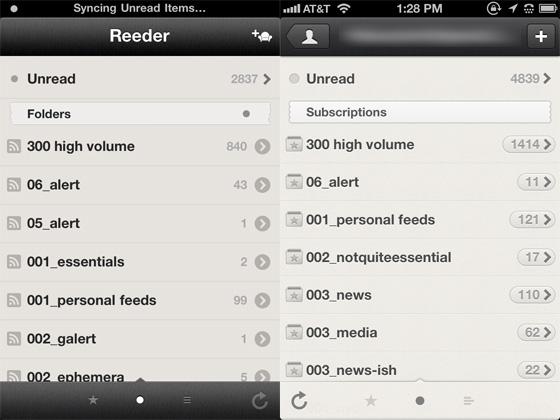
You can finally add RSS feeds from within the app
For first time users, Reeder offers a straightforward interface without tons of bells and whistles (above on the left is the old app, on the right the new app). The app is mostly gradations of gray, with feed favicons offering the only hint of color outside of images in individual feed items. Regular users of Reeder will appreciate many of the subtle new animations across the app like pop-over alerts, accordion bends, and tiny shakes as new feed items snap into place. Your RSS feeds are sorted by folders, and clicking through to any folder (or your entire list of items) gives you the option of viewing by starred or unread items, or broken down by feed. After two major revisions, users can finally add new RSS feeds from within the app, instead of requiring you to manage from a desktop browser.
On startup, you'll notice that your account settings, services, and more have been moved out of the iOS Settings and integrated directly into Reeder's new settings section. Reeder's always been known for its deep support for sharing services, and the 3.0 update is no slouch, with new additions like QUOTE.fm and Buffer added to the Instapaper and Evernote standbys. I've always liked Reeder's ability to pop up a share menu on nearly everything in the app, ranging from links and highlighted sections to individual articles. The sharing overlay got a subtle transparent black redesign, and it's a shame the options can't be enabled across iOS; Android really got sharing right.

Gestures!
At the top of the item feed, you'll find a Readability icon for saving articles to read later; unfortunately this can't be switched out for Instapaper or Pocket. There's also a quick access menu for adjusting type size and line height. Swiping from left to right moves you back to the full feed list view, and swiping right to left loads the web view. These gestures don't work when you're viewing a full list of feed entries, so you can't swipe all the way back to the top directory. Instead, swiping on individual items can be customized for quickly marking as read or sending the item to services like Instapaper, Pocket, and Readability. Swiping up on an item reveals an accordion card interaction that Silvio Rizza told me was inspired by the OS X Mail.app paperfold. Pulling on it past a certain point and releasing causes the next feed to load.
Serious news junkies now have the option to add multiple accounts, and the app now supports Shaun Inman's Fever service as well. It's nothing too special — you can dig into your folders, unread list, and the hot section — but it's good to see support for other services. Interestingly, you can also hook up your Readability account as a source account to keep your entire reading list and your RSS feeds all in one app. Hopefully, Instapaper and Pocket support will be added in future versions.
I've got hundreds of feeds in my personal Google Reader account, so I'm greeted most mornings by a couple thousand unread items. The old app handled these just fine, but the 3.0 update is just slightly more sluggish in testing when moving between folders, lists, and individual feed items on an iPhone 4S. More importantly, there's still no in-app search function for quickly digging into your feeds, and there aren't any feed management tools. Unfortunately, there's still no Notification Center support, so you can't set up alerts for specific feeds in case of breaking news or cat videos.
Wrap-up
RSS readers are in a weird place these days. Algorithms and social networks have popped up since the early days of RSS to give us more "relevant" news and links, but there's still something satisfying and useful about diving into your own feeds, and a quality feedreading tool is as essential as ever. Reeder's clean design and no-nonsense approach to feedreading won't make it the next billion dollar app, but it's not trying to be that. For anyone that needs to keep up with RSS feeds on their phone, Reeder is well worth checking out. It's available now as a free upgrade in the App Store.
RSS chief expresses displeasure at ousting Sanjay Joshi from BJP - Hindustan Times
A senior sangh pracharak, who preferred anonymity, claimed that the recent editorial in BJP mouthpiece ‘Kamal Sandesh’ that no leader should consider oneself bigger than the party was in fact, Bhagwat’s opinion, which he is believed to have echoed before his close lieutenants. That Modi had his way on Joshi’s exit was also considered as the former’s sheer display of arrogance, driven by a clash of egos by the Sangh Parivar.
According to him, the Sangh preferred to keep mum on the whole "drama" in view of the ensuing Gujarat elections and a smooth passage for Nitin Gadkari’s re-election as party president.
Moreover, the Sangh Parivar did not want a message to be sent across that Gadkari’s re-election to the BJP top post by amending the norms in the national executive did not have a powerful leader like Modi’s approval, who also considered a face of ‘Hinduvtava’ and his ever-growing clout in the party.
Joshi, first sent to the BJP by the RSS in 1988 to use his organizational skills in building the party in Gujarat, had to leave in 2005 over a sleaze CD. After taking over as BJP president, Gadkari rehabilitated Joshi -- his childhood friend -- in view of his organizational ability and entrusted him the job of Bihar and UP elections. Joshi was also included in the national executive, which did not go down well with Modi. Joshi’s friend-turned-foe Modi refused to campaign in the UP elections for the party and unofficially boycotted the national executive. Moreover, of late, the Gujarat chief minister was not even taking Gadkari’s phone calls.
When Gadkari rang up Modi on May 23, just before the national executive at Mumbai and requested him to attend, the Gujarat chief minister laid down the condition of Joshi’s axe from the executive.
Gadkari, a darling of Bhagwat, tried to use his good offices in RSS for intervention, but in vain. The BJP president did not dare to take risk when the senior party leader Lal Krishna Advani blogged questioning his leadership and other senior party leaders including Sushma Swaraj and Arun Jetlay were hostile. He narrated the entire things before Joshi who "sacrificed" himself for his friend to pave way for Modi attending the Mumbai meet.
But as pro-Joshi posters appeared in Delhi and some places in Gujarat, Modi made a telephone call to Gadkari, asking the latter to either relieve him from his chief minister’s post or Joshi from the party. Faced with this ultimatum, Gadkari made yet another crafty move by making Joshi to resign as BJP’s election in-charge of UP.
However, the RSS headquarters claimed that Joshi would be honourably re-inducted in the organization after Gadkari’s re-election the December Gujarat elections are over this year. It was said that he would be given an important task of Madhya Pradesh and Chhattisgarh elections to be held in October next year, the pracharak claimed.
Given a belief held by section of RSS cadres, it seems that the RSS would not tolerate Modi’s arrogance for a long. The RSS, which is literally directing the BJP affairs, may take on Modi after the Gujarat polls and Gadkari’s re-election by end of this year.
The senior RSS leader and former Buddhik Pramukh of the saffron organization, MG Vaidya, said that the party is bigger than any individual. “The Modi-Joshi tussle is not good for the party,” he pointed out.
Meanwhile, neither Gadkari nor Bhagwat was available for comments. Joshi who was here to attend a meeting of RSS said that he was still in the BJP. "I have only relinquished the national executive and UP in-charge. I am still a primary member of the party," he said.
Talking to Hindustan Times, he also dismissed the rumours that he would be given the job of Vanvasi Kalyan Ashram by the RSS. Joshi met Vaidya during his Nagpur visit and had a long discussion.
0 Responses to "Analysis: Gupta's fate may hinge on witnesses, not wiretaps - Reuters"
Post a Comment